Yuga Signal/Nov 25, 2026/3 min
Hera sees what DART did to an asteroid, beside Nyāya's 'direct seeing'
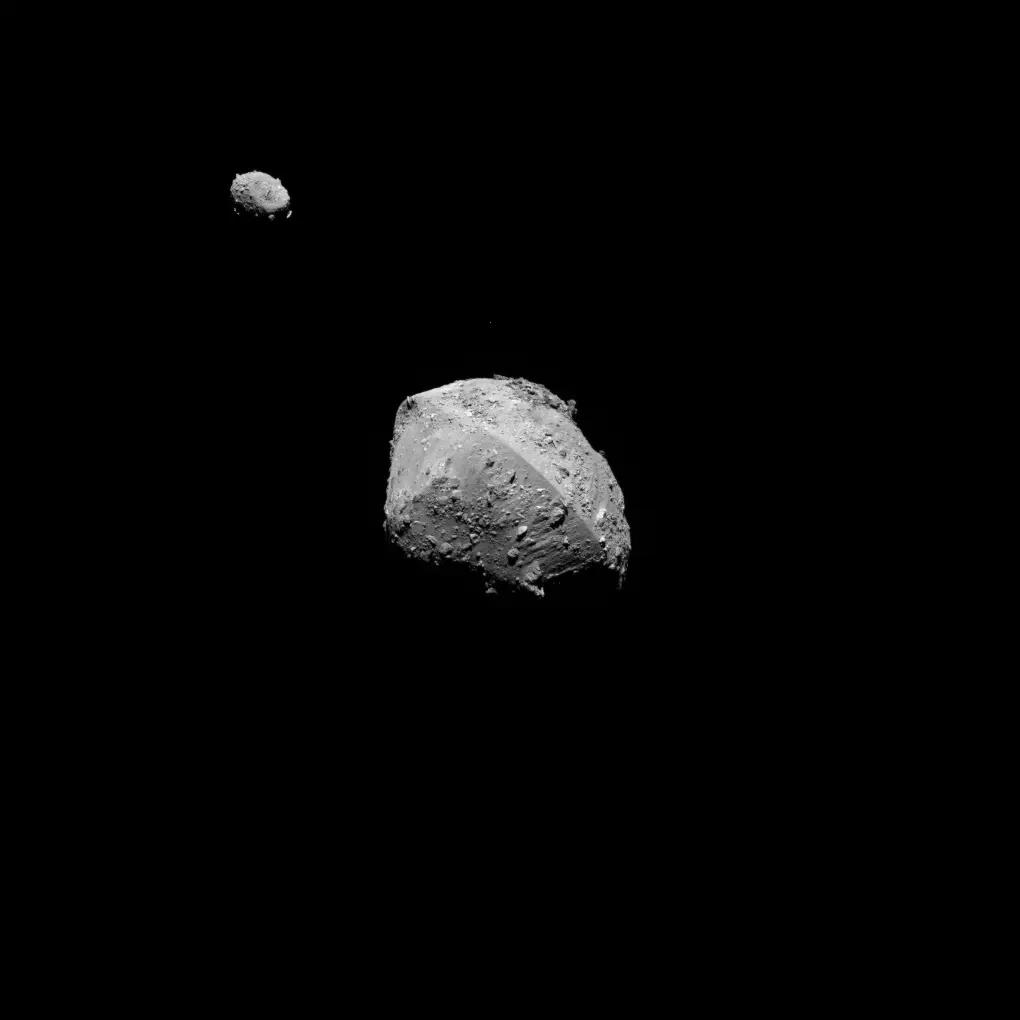
ESA's Hera spacecraft has reached Dimorphos, the small asteroid NASA's DART hit in 2022. One face is flattened by a stadium-sized crater, the body is tumbling, and hundreds of boulders circle the pair.
Textual parallel
Nyāya Sūtra 1.1.3–1.1.4 (core line 1.1.3; definition 1.1.4)
Principle: pratyakṣa, direct seeing as a means of knowledge
Yuga signal
Stewardship
Stage: First-look images from an operating mission; no peer-reviewed analysis yet
On Nov 25, 2026, ESA reported that the Hera spacecraft had reached the Didymos–Dimorphos binary and returned its first close-up images. ESA reports that DART's 2022 impact flattened the face it struck into a crater that ESA calls stadium-sized and that, per Patrick Michel, "extends across the asteroid's entire width". The rest of Dimorphos looks as it did in DART's 2022 images. The impact also left the 151 m moonlet "tumbling wildly in its orbit" (mission scientist Michael Kueppers). Hundreds of previously unknown boulders, a few metres across, orbit the pair. DART had shortened Dimorphos's orbit by 33 minutes, far more than models expected.
Hera now flies 25–30 km out; it moves to about 13 km in December and releases the Juventas and Milani CubeSats in January 2027. ESA's framing: DART showed an asteroid's orbit can be changed; Hera shows what that did to the asteroid itself, a step toward making deflection "a reliable tool".
These are first-look agency statements, not a peer-reviewed analysis. Dimorphos and Didymos pose no threat. ESA says the April 13, 2029 Apophis flyby is "entirely safe".
The parallel
pratyakṣānumānopamānaśabdāḥ pramāṇāni
Nyāya Sūtra 1.1.3: "Perception, Inference, Analogy and Word are the Pramāṇas" (Ganganatha Jha, 1915, Wisdomlib; Sanskrit matches GRETIL).
indriyārthasannikarṣotpannam jñānam avyapadeśyam avyabhicāri vyavasāyātmakam pratyakṣam
Nyāya Sūtra 1.1.4: "Sense-perception is that cognition—(a) which is produced by the contact of the object with the sense-organ,—(b) which is not expressible (by words)—(c) which is not erroneous,—(d) and which is well-defined" (Jha, 1915, Wisdomlib). The IAST follows GRETIL.
Why it sits here
A comparison, not foresight. After DART's 2022 impact, measurements from Earth showed that Dimorphos's orbit had shortened by 33 minutes, more than models expected, but ESA says a basic question was still open: what had actually happened to the asteroid itself? Scientists debated whether it had a crater, had changed shape, or was unchanged. Hera answers by going to look. The Nyāya Sūtra puts direct perception first among the ways of knowing, and defines it as cognition from contact with the object, not erroneous, well-defined. The rhyme is in the method: a debated consequence of an action is settled by seeing the object itself. Nothing in the sūtras describes asteroids or spacecraft, and this card does not say Nyāya predicted planetary defence.
The Yuga signal
Stewardship. First-look images from an operating mission; no peer-reviewed analysis yet. One small asteroid, one test. Numbers on mass loss, momentum transfer and the interior wait for closer passes, the Juventas radar and Milani, and peer-reviewed papers. A "reliable tool" needs knowing how different asteroid types respond, plus early detection and lead time.
Also read
Yuga Signal
Get Yuga Signal updates
Leave an email for the next cards. No membership. This list is not sold.
Or let a bot bring each new card to you, written for what you care about. Two steps: