Lesson/Oct 26, 2026/4 min
Why is Ram blue?
Not a skin tone. A color for what is too vast to see whole: sky, ocean, and the word the texts actually use, shyama.
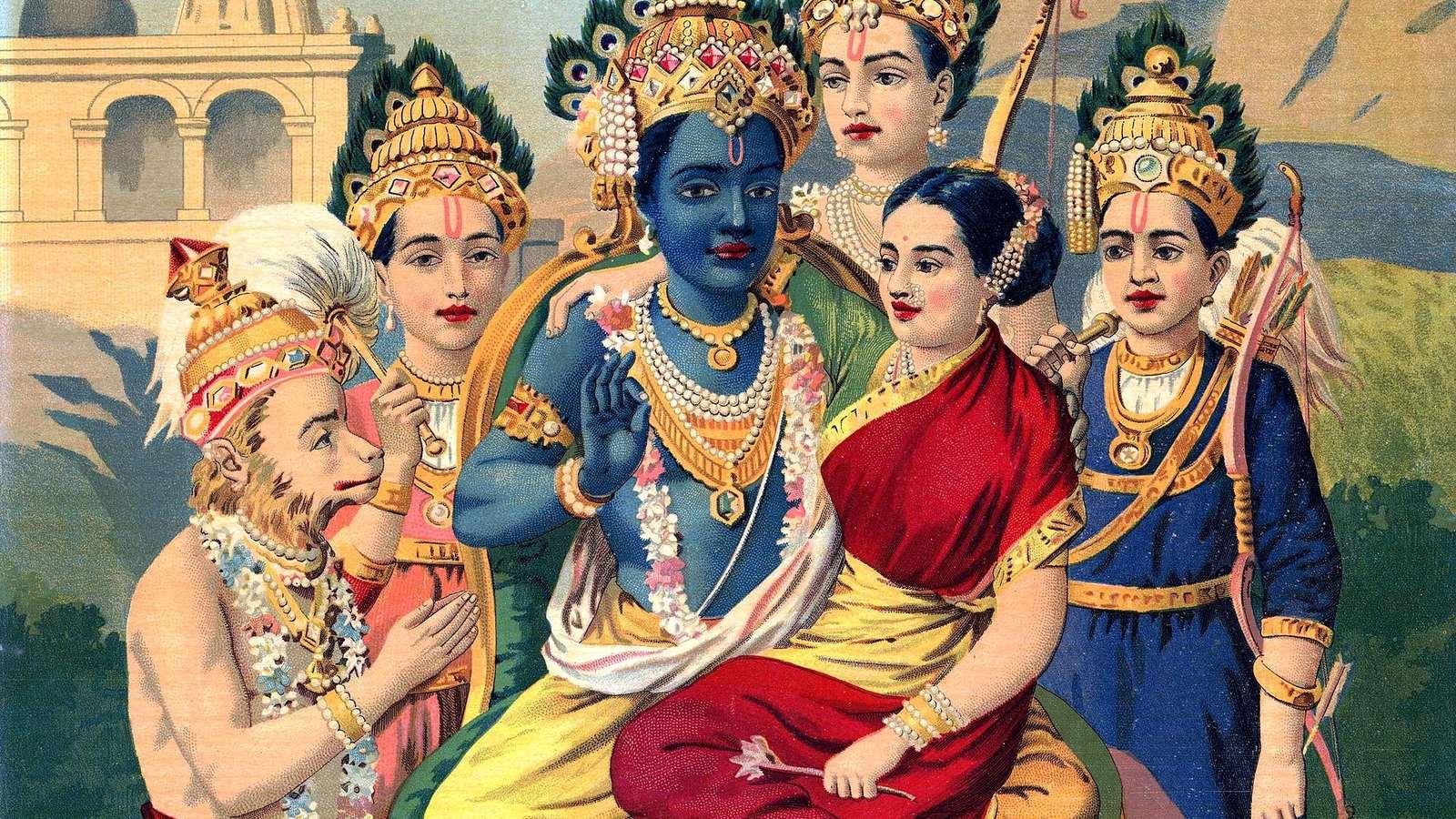
Every child who grows up near a Ram Navami calendar asks it sooner or later. Why is Ram blue? Nobody in Ayodhya had blue skin. The question is a good one, and the answer says more about how the Eternal Order teaches than about pigment.
A recent explainer from the channel Sanatan Puranas, Why Hindu Gods Have Blue Skin: The Scientific & Spiritual Reason (January 2026), puts the question to Rama, Krishna and Shiva together. In its own words, it explores "the artistic history, the concept of the 'infinite' sky and ocean, and the spiritual aura descriptions in ancient texts." Those three threads are worth pulling one at a time.
What the texts actually say
The older words are not quite "blue." The word that keeps coming back is shyama: dark, dusky, the deep color of a rain cloud before monsoon. It sits next to nila, the darker blue of a lotus or of deep water.
Tulsidas, writing the Ramcharitmanas in the sixteenth century, opens with a line that later painters seem to have taken literally: nila saroruha shyama, taruna aruna barija nayana. Dark as the blue lotus, with eyes like a fresh red lotus. The image is a flower, not a person's complexion. It is a comparison meant to be felt.
In Valmiki's Ramayana, Rama's body is praised for its glow and depth of color rather than for a hue you could match on a chart. You can read the Sanskrit and a line-by-line translation at the IIT Kanpur Valmiki Ramayana project.
So the first answer is linguistic. The poets reached for the color of rain clouds and blue lotuses. Painters, especially once printing arrived, turned shyama into a bright, unmistakable blue.
The sky and the ocean
The second thread is the one the video leans on most. Look at what is blue in the world: the sky, and the deep sea. Both share one quality. You cannot see the edge of either.
Water in a cupped hand is clear. Water across a whole ocean reads as blue. Air in a room is invisible. Air across the whole sky reads as blue. Blue is how the eye reports something too large to be held at once.
That is the point of painting Rama this color. In this way of thinking he is a prince of Ayodhya and also something that does not end where his body ends. The color is a teaching device. It tells you, before any story starts, that this figure stands for the vast inside the particular.
Vishnu, of whom Rama is understood as an avatar, is shown the same way, and so is Krishna. The family resemblance is deliberate.
Aura, not skin
The third thread is the oldest kind of commentary. Teachers in many traditions have said these figures were never literally blue. People around them perceived a presence so deep that dark-blue words were the only ones that fit. The video gathers these descriptions under the idea of an aura.
You do not have to accept the aura claim to see the logic. It is the same move as the sky and the ocean. The blue marks a quality: depth, steadiness, a mind that can contain much without being moved by it.
Why it matters for how we read the Ramayana
The Ramayana works as a long training in choosing well under pressure. The blue figure at its center is a reminder that the ideal is not a narrow, perfect individual. It is a person whose inner horizon is as wide as the sky. Calm in exile, calm in war, calm in return.
Read this way, the color stops being a puzzle and becomes an invitation. Rama is blue because the philosophies behind him are asking you to be a little more like the sky: wide enough that anger, grief and praise pass through without staining you.
The next time a child asks why Ram is blue, there is a real answer. The poets said he was the color of rain clouds and blue lotuses. The painters made it vivid. And the color itself points at something larger than anyone can see in one look.
Sources and further reading
- Sanatan Puranas, Why Hindu Gods Have Blue Skin: The Scientific & Spiritual Reason, YouTube, January 19, 2026.
- Valmiki Ramayana, Sanskrit text and translation, IIT Kanpur.
- On the word shyama and its color sense, see Shyama (Wikipedia) and the iconography section of Rama (Wikipedia).
- Cover: Raja Ravi Varma, Ramapanchayan (lithograph), public domain, via Wikimedia Commons.

For a related piece, read Rama's choice.